Woodrow Wilson by Walworth Arthur 1903-
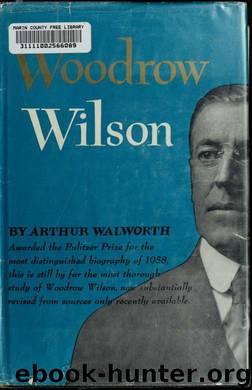
Author:Walworth, Arthur, 1903-
Language: eng
Format: epub
Tags: Wilson, Woodrow, 1856-1924
Publisher: Boston, Houghton Mifflin Co.
Published: 1965-03-13T16:00:00+00:00
could never be overcome. Soon after the close of the Cabinet meeting on that day, and before he could start on his afternoon automobile ride, the President was handed a terse cablegram reporting that the Lusitania had been sunk by a submarine. One hundred and twenty-eight Americans were lost, among them thirty-seven women and twenty-one children. The ship was unarmed and was unprotected by a convoy, carried no troops, but had thousands of cases of ammunition in her hold.
When news of the disaster reached Wall Street, stock prices fell abruptly. In the view of the American press the act was palpably a slaughter of innocents, a barbarity without precedent in modern times. The mail sacks coming to the executive offices bulged with protests and resolutions from the citizens. Would the President hold Germany to the "strict accountability" that he had proclaimed ?
Woodrow Wilson was stunned. He did not trust himself to express his thoughts, but left the White House quickly and walked a long way, alone, until his wrath was under control. Later he accepted Dr. Grayson's prescription of golf as usual.
When Tumulty tried to give "the Governor" a lurid account of the tragedy, Wilson silenced him, explaining that if he gave too much heed to heart-rending news stories he would "see red in everything" and could not act justly. He was not afraid to lead the nation to fight, he said, but he must not do it hastily or prematurely. If he went to the Congress the next day and asked for a declaration of war, he would be supported; but when the casualty lists came and people read them, might they not wonder why their President had rushed into war with Germany after he had been so indulgent of Great Britain, why he did not first exhaust every possibility of peaceful settlement? When he moved against Germany—and he now felt that he might eventually be forced to move—he wanted his people to be united and enthusiastic for a crusade. Moreover, he was governed by a sense of trusteeship not only to his own people, but to the whole civilized world. He foresaw that if the United States, the only mighty nation still standing aloof, were to join in the fight, civilization might be bankrupt in every respect.
He left his desk on the evening of May 10 to fulfill a promise to speak at Philadelphia to several thousand citizens who had just been naturalized. These immigrants before him were men whom Congress wished to exclude unless they could prove themselves literate; but by an executive veto Wilson had redeemed a political pledge and had kept the door open to the educational opportunities that his nation offered.
He began nervously, rocking back and forth on his heels, and his
Download
This site does not store any files on its server. We only index and link to content provided by other sites. Please contact the content providers to delete copyright contents if any and email us, we'll remove relevant links or contents immediately.
| Military | Political |
| Presidents & Heads of State | Religious |
| Rich & Famous | Royalty |
| Social Activists |
Waking Up in Heaven: A True Story of Brokenness, Heaven, and Life Again by McVea Crystal & Tresniowski Alex(37815)
Empire of the Sikhs by Patwant Singh(23090)
We're Going to Need More Wine by Gabrielle Union(19053)
Hans Sturm: A Soldier's Odyssey on the Eastern Front by Gordon Williamson(18596)
Leonardo da Vinci by Walter Isaacson(13341)
The Radium Girls by Kate Moore(12036)
Tools of Titans by Timothy Ferriss(8403)
Educated by Tara Westover(8060)
How to Be a Bawse: A Guide to Conquering Life by Lilly Singh(7493)
Permanent Record by Edward Snowden(5852)
The Last Black Unicorn by Tiffany Haddish(5642)
The Rise and Fall of Senator Joe McCarthy by James Cross Giblin(5284)
Promise Me, Dad by Joe Biden(5157)
The Wind in My Hair by Masih Alinejad(5103)
A Higher Loyalty: Truth, Lies, and Leadership by James Comey(4966)
The Crown by Robert Lacey(4820)
The Iron Duke by The Iron Duke(4367)
Joan of Arc by Mary Gordon(4117)
Stalin by Stephen Kotkin(3973)
